 homyna.com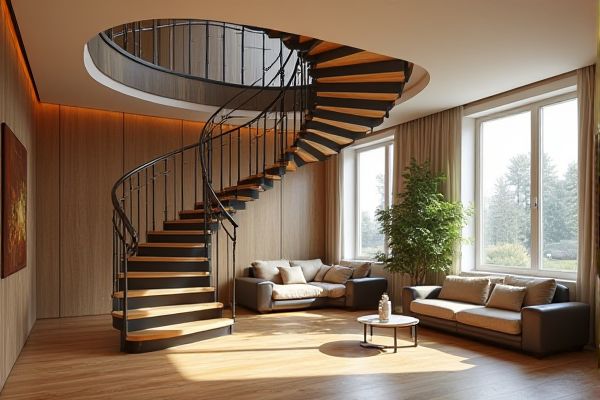
A double helix staircase features two intertwined spirals that allow simultaneous ascent and descent without interference, optimizing space and traffic flow in architectural design. Explore the rest of the article to uncover how double helix staircases compare to traditional spiral staircases in form, function, and aesthetic impact for your projects.
Table of Comparison
| Feature | Double Helix Staircase | Spiral Staircase |
|---|---|---|
| Design | Two intertwined helical staircases winding around a common core | Single helical staircase winding around a central pole |
| Space Efficiency | Requires more space due to two separate spirals | Highly compact, ideal for small spaces |
| Usage | Often used in grand architectural designs and landmarks | Common in residential and limited space areas |
| Traffic Flow | Supports simultaneous two-way movement on separate helices | Typically single-direction, may cause congestion |
| Aesthetic Appeal | Complex and visually striking with intertwining form | Sleek and simple spiral form |
| Construction Complexity | High complexity, requires advanced engineering | Relatively simple to design and build |
| Cost | Higher cost due to intricate design and materials | More affordable, less material intensive |
Introduction to Double Helix and Spiral Staircases
A double helix staircase features two intertwined helical flights that circulate around a central axis without intersecting, creating a dynamic architectural form often used in iconic structures like the Chateau de Chambord. In contrast, a spiral staircase consists of a single helical flight that winds around a central pole, optimizing space efficiency in residential and commercial buildings. Both types exemplify unique engineering principles, with double helix staircases offering simultaneous two-directional flow and spiral staircases providing compact vertical circulation.
Defining the Double Helix Staircase
The double helix staircase features two intertwined helical stairways that allow simultaneous upward and downward movement without intersecting paths, a design famously exemplified by the Chateau de Chambord in France. Unlike a traditional spiral staircase, which consists of a single winding flight around a central axis, the double helix staircase provides enhanced spatial efficiency and visual complexity. Your architectural choices can benefit from the double helix structure by combining functionality with striking aesthetic appeal.
Understanding Spiral Staircase Design
Spiral staircase design optimizes space by winding steps around a central pole, creating a compact and efficient vertical connection. Double helix staircases feature two intertwined spirals, allowing simultaneous upward and downward traffic without interference. This unique design enhances flow and architectural interest, especially in modern or large-scale buildings.
Historical Origins and Examples
The double helix staircase, famously exemplified by the Chateau de Chambord in France, dates back to the Renaissance and showcases two intertwined spirals that allow individuals to ascend or descend without crossing paths. Spiral staircases, with origins tracing to medieval Europe and earlier ancient civilizations, feature a single helical structure winding around a central column, commonly seen in castles and lighthouses. Both designs reflect unique architectural innovations, with the double helix emphasizing separation of movement and the spiral optimizing vertical space in confined areas.
Key Structural Differences
A double helix staircase consists of two intertwined helical flights that rotate around a shared central axis without intersecting, offering separate but connected pathways. In contrast, a spiral staircase features a single helical flight winding around a central pole, providing a compact footprint. Understanding these key structural differences can help you choose the staircase design that best suits your space and functional requirements.
Space Efficiency Comparison
Double helix staircases maximize space efficiency by incorporating two intertwining staircases within the footprint of a single traditional staircase, allowing simultaneous upward and downward traffic without interference. Spiral staircases, while compact and suitable for tight spaces, typically accommodate only one user at a time and require more vertical clearance. Your choice depends on balancing spatial constraints with traffic flow needs, as double helix designs optimize both better than standard spiral configurations.
Aesthetic and Architectural Impact
Double helix staircases create a striking aesthetic with their intertwined structures, often symbolizing complexity and innovation in architectural design. Spiral staircases, characterized by their single helical form, provide a sleek, space-saving solution that enhances vertical movement while adding elegance to compact areas. Both designs serve as sculptural elements, but double helix staircases offer a more dramatic visual impact and dynamic spatial experience.
Practical Uses and Applications
Double helix staircases are commonly used in architectural landmarks and scientific institutions, providing efficient dual-directional traffic flow without interference, ideal for high-traffic areas like museums and laboratories. Spiral staircases are preferred in compact spaces and residential settings, offering a space-saving design that enhances aesthetic appeal while facilitating vertical movement in tight floor plans. Both stair types serve unique functional purposes, with double helixes optimizing simultaneous ascent and descent and spirals maximizing space efficiency.
Advantages and Disadvantages
Double helix staircases maximize space efficiency by allowing two continuous staircases to intertwine without intersecting, ideal for high-traffic areas and architectural statements. Spiral staircases offer compact design and easy installation, best suited for limited spaces but can be challenging to navigate and less accessible for those with mobility issues. Your choice depends on balancing aesthetic appeal, spatial constraints, and functional needs.
Choosing the Right Staircase for Your Project
Double helix staircases offer a unique architectural statement with two intertwined staircases allowing simultaneous upward and downward movement without interference, ideal for spaces requiring high traffic flow and visual impact. Spiral staircases are more compact, making them suitable for tight spaces or projects prioritizing space efficiency and aesthetic simplicity. Your choice depends on spatial constraints, functional needs, and the desired design statement for your project.